Thursday, February 17, 2011

Carbon Dating by: Austen Werab


I. Introduction
Carbon dating is a method of using naturally made carbon to estimate the age of materials up ranging from 58,000-62,000 years. The discoverer of this method of age estimation was Willard Libby, an American physical chemist. He developed this method in 1949 with some help from his colleagues at the university of Chicago. This method is said to have revolutionized archaeology and is still used to this day.
II. Discovery
This method of finding the age of fossils by using carbon from the sun (carbon dating) was discovered by Willard Libby in 1949. Willard was curious about the cosmic radiation from the sun that hit the earth, and he then was determined to find out how it could be noticed or detected. He soon then came up with his theory that stated that every living thing takes in C14 (carbon-14) and when it dies, the C14 decreases until it eventually disappears, but it doesn't diminish completely, it stays at a set rate which is half of the carbon that the item had before it ceased (7). He hypothesized this theory in 1946. As many times as Willard tried to prove this, he couldn't because there were many other natural sources giving off carbon so he and is colleagues used a Geiger Mueller radiation detector that they modified to find the carbon radiation that they wanted to find to prove his hypothesis. This reduced outside carbon source by 95%. This is how Willard first started to discover the radiation that came from the carbon, thus creating the method of carbon dating.
III. Biography of discoverer
Willard Libby (1908-1980)
He was born in Grand Valley, Colorado on December 17, 1908. He received his B.S. and PhD at the university of California in Berkeley, where he later became a professor. After the start of WWII, he started the Manhattan project at Columbia university, he was responsible for the gaseous diffusion of Uranium-235 that was later used in the atomic bomb that was dropped on Hiroshima. In 1945, he became a professor at the university of Chicago which led to his hypothesis (listed above) in 1946, with the help of his colleagues. And in 1960 he was awarded with the Nobel Prize in Chemistry for his development of the carbon dating method.
IV. Impact on the world/humanity
This method is good and still is good because it can be used to date materials back to about 50,000 years ago or more. Scientists can use this method as long as there are earth made or organic materials on the earth and they can use this to develop calendars and historical charts/timelines of their findings. For example, say a group of scientists find a dinosaur skeleton and date it back to a long time ago, they can now start a calendar and map how different species of dinosaurs that they find showed up and what time period they showed up around by using carbon dating. They can basically use it to see how old the species is and how long it has been fossilized. Archeologists around the world still use this method to this day!
V. Journal article review
This journal article is about how many scientists think that Neandertals lost their evolutionary fight with Homo sapiens to become the Earth's dominant human life form. These scientists all want to see how long this battle lasted , so they decided to use the famous method, carbon dating. And it also explains how these scientists are hoping to develop a time line back to the 60,000 year point to map out everything that happened between these two species, and they will figure it out all thanks to carbon dating.
YOUTUBE video- http://www.youtube.com/watch?v=31-P9pcPStg
VI. References -
1. http://en.m.wikipedia.org/wiki/Willard_Libby
2. http://www.parks.ca.gov/?page_id=24000
3. Journal article: http://www.questiaschool.com/PM.qst?a=o&d=5028583679

Bugatti Veyron Super Sport


What is the Fastest Production Car in the World

Introduction:
What is the vastest production car in the world? The answer was a Bugatti Veyron 16.4. A Italian car made in France and also in Germany. The car has a 8.0 liter W16 engine with sixteen cylinders in four banks of four. The engine is fed by four turbochargers and is 7,993 cubic centimeter. If you don’t understand what I just said then listen to this. It has 1,001 horse power (hp) thats only about lets say, 880 horses more than Sammy Bozzas ford focus! And when his car has only 1 radiator to cool his car, the Bugatti has 10. And the Bugatti goes 0 - 60 mph in 2.5 seconds, and0 - 100 in 7.5 seconds, when Sam's Ford goes 0 - 60 in 8 seconds. And the Bugatti tops at a blistering 253 mph which covers one wholefootball field a second, and consumes and 2 gallons of fuel a minute. And you can get all this for a total of only 1.7 million dollars. But.... America created a car called the Shelby Ultimate Arrow that would top 256 mph, making it the fastest car in the in the world. Until a couple months latter Bugatti came out with a new beast to reclaim its title, “The Bugatti Super Sport.”
Discovery :
The Bugatti Veyron 16.4 Super Sport is now the fastest production car in the world launched in August 2010. But to create this monster the normal Veyron was added a Volkswagen golf hp’s to it, which makes it now 1200 hp. And if your wondering why it need another 200 hp’s too give it a couple more mph was because of mother nature. Air resistance and friction is the only thing holding this car back. The faster you go the thicker the air becomes against the car. For example at 100 mph air resistance is like driving threw a light wiped cream, but at 200 mph its like a very thick cream cheese, and at 250 mph its like driving threw a fruit cake. And so cutting threw the fruit cake requires more than just added power but larger turbochargers, enlarged coolers, and, a new slippery carbon fiber body making it a full 110 pounds lighter. The Super sport goes 0 - 60 in 2.5 seconds which is the same as before, but besides that the car is a whole different animal. The supper sport goes 0 - 100 mph in 4.5 seconds which is almost two times faster than Jays Nissan Extera 0 - 60 mph time! The Bugatti Super Sport top speed is 267 mph, and this is no rocket ship it has air conditioning, a radio, and windscreen wipers. And cost a grand prize of 1.7 million pounds or 2.4 million dollars.

Purpose:

The purpose of this car was no cure for disease or travel to another plant but mastering the physics of friction, air resistance and pure power in a production car. This car has changed boundaries that cars can reach and will push others in the future this car will never be forgotten and forever challenged by its world record top speeds for a production car that is legal to drive on a public rode. This car purpose is to go fast!

Impact on the world:

The impact on the world was to blow peoples minds as being the first quad turbochargers in any car. And shock people on the amount of technology, time,and effort to create such a car that sets limits of insane engineering. This car is a stop and stare car with the engine underneath and the perception of the body on top.

One of the Few Places to Max a Bugatti:

For the Bugatti to hit its top speed it takes miles more miles to top out. So Bugatti went to Volkswagens top secret test track which is a huge 30 mile oval shape track that was built in an older cold war no fly zone near the old East German boarder. And the best part is that this test track has a 5.5 mile long flat straight road, it so long you can see the earths flex. It is one of the very few places in the world where you can max out a Bugatti. At the track the Bugatti crew waited on till the wind was calm and when the air was at its thinest. Another part of topping a Bugatti is the tires the tires were made to last 26 miles at its top speed and cost 20 thousand dollars. The crew said it was safe on these tires because the driver was told that the car would run out of fuel before the tires would break because it uses so much fuel exactly 1.7 gallons a minute at those speeds.


Journal Article: http://www.bugatti.com/en/super-sport/technology.html

The journal Article was the official web site for Bugatti veyron Super Sport. It talked about how they enlarged the turbo chargers, made the intercoolers better, made stronger role bars, increased the aerodynamics, and increased balance of the car by adding a carbon fiber body. Their goal was to create a classier faster sport car far above any other. And hell yes they did.


References:


"Bugatti." Bugatti. Web. .

"Bugatti Veyron 16.4 Super Sport Hits 268 Mph - Auto Week Magazine." Car News, Reviews and Auto Show Stories, Photos and Community. Web. 17 Feb. 2011. .

"Bugatti Veyron Pictures, Specs, Price, Engine & Top Speed." Supercars – Car Reviews, Pictures and Specs of Fast Cars & Used Cars. Web. 17 Feb. 2011. .
"Motor Trend." Bugatti Super Sport. Web. .

"YouTube - James May's Bugatti Veyron Top Speed Test - Top Gear - BBC Autos." YouTube - Broadcast Yourself. Web. 17 Feb. 2011. .

"YouTube - SSC Ultimate Aero - Guinness World Record Run - 255.8mph." YouTube - Broadcast Yourself. Web. 17 Feb. 2011. .

Cochlear Implants: Miracle Machines

By: Katerina Parent


I.              Introduction
Cochlear implants are surgically inserted electronic devices that are used to help hearing impaired or deaf people hear. This device is very complex, one part having to be placed inside the person’s head just above the ear, and the rest simply clipped on the lobe of the ear. First used in Australia in 1978 by Dr. Graeme Clark, cochlear implants have helped tens of thousands of children and adults hear their friend on the phone, listen to a teacher’s lecture, and hear their mother’s voice. The cochlear implant is a miracle machine that has changed people’s lives. (National Institute, 2010)

II.           Discovery
         Over the last few centuries, scientists all over the world have experimented with finding a way to help hearing impaired or deaf people hear. It all began in the late 18th century when Alessandro Volta discovered the electrolytic cell by putting two metal rods connected to batteries in his ears. Hundreds of experiments were further tested until one man, Dr. Graeme Clark, and his team discovered that “nerve cells in the inner ear can be made to respond back into the inner ear…” and that “nearly normal sound could be reproduced by sending fine patterns of nerve fibers through to the inner ear.” These early findings were the key to creating the first bionic ear. (National Institute, 2010)
         After years of continuous research all around the world, and even a trip to the beach where Clark had a breakthrough using a seashell as the cochlea, he was able to perform the first surgery ever on 46-year-old Rod Saunders. The first cochlear implant operation was performed at the Royal Victorian Eye and Ear Hospital by Clark and fellow surgeon Dr. Brian Pyman. (National Institute, 2010)

III.         Biography of Investigator


         Dr. Graeme Clark was born in New South Wales on August 16, 1935. He received most of his education in Australia, and graduated from the University of Sydney in 1957 with a Bachelor’s degree in medicine and in surgery. After college, he studied mostly in England, starting at a young age to research and eventually create an implant to aid his deaf father. (Kissiah, 2007)
         Clark wondered if hearing could be possible if the damaged or underdeveloped ear could be bypassed and have the auditory nerve stimulated electronically. This would reproduce the coding of sound. After much research, he concluded that an electrode bundle could pass around the cochlea to the speech frequency to produce sound that people could understand but he wasn’t sure how to achieve this without causing damage to the cochlea. After discussing this with his team of doctors, Clark was able to configure the device so that the electrode bundle was free fitting and friction of the wires was reduced with circumferential bands. These bands needed to be the perfect size. It had to be wide enough so that it could decrease the density charge of the electrical current and narrow enough to stimulate the nerve fibers so that the coding of frequency could occur. It also had to be safe enough to test on a real person and hopefully achieve the predicted outcome. His cochlear implant was a complete success and he went on to receive numerous awards for his work with colleague Yit Chow Tong on frequency, pitch, loudness, and elements for speech understanding for the device Clark had created. He was recognized by the FDA in the United States for the implant, and received nine awards during the years of 1985-2010 including the Prime Minister's Prize for Science in 1985. (Kissiah, 2007)
         Dr. Graeme Clark founded the Bionic Ear Institute in 1983 and worked at the University of Melbourne as the Foundation Professor of Otolaryngology for thirty-four years and retired in 2004. He is still alive today and continues to share his dream of “giving deaf children and adults the opportunity to participate as full as possible in the hearing world and to find new ways to restore brain function." (Anderson, 2011)

         IV. Impact on the World


         In 2009, the FDA released data saying that about 188,000 children and adults
around the world have cochlear implants. In the United States alone 41,000 adults and 25,000 children make up this number. Anyone 12 months and older have the option to be fitted for an implant. With an implant, people who are hearing impaired are able to learn to associate different noises with sounds they remember. For those with an implant who are deaf, through speech therapy, they are able to acquire language and social skills.
         The surgical procedure for a cochlear implant is expensive, and the amount of therapy required to learn how to hear can be a lot based on how easily you are able to interpret noises into words. And although it is said to be a very safe operation, every surgery has its complications so it is highly advised to talk to a doctor with great experience with this procedure to get the best results.
(National Institute, 2010)

V.            Journal Article Review
         The journal article that I found by Adam M. Kissiah, Jr. from the NASA-Kennedy Space Center and Institute of Electrical and Electronic Engineers is titled, “Cochlear Implant Technology.” This article had great information about the history of cochlear implants and their creator Dr. Graeme Clark. Included in the section explaining how the implant works, Kissiah included a link to the fda.org website that shows great pictures of auditory system.
Animation: Normal Ear, Ear with Hearing Loss, and Cochlear Implant Procedure
http://www.fda.gov/MedicalDevices/ProductsandMedicalProcedures/ImplantsandProsthetics/CochlearImplants/ucm133345.htm

VI. Resources


Anderson, J. (2011). Professor Graeme Clark. Retrieved on February 15, 2011 from 
Kissiah, A. (2007). Cochlear Implant Technology. Retrieved on February 15, 2011 from http://www.hearagain.org/history_of_the_cochlear_implant.pdf
National Institute of Deafness and Other Communication Disorders. (2010)
Cochlear Implants. Retrieved on February 15, 2011 from http://www.nidcd.nih.gov/health/hearing/coch.html
Wikipedia. (2011). Graeme Clark (doctor). Retrieved on February 15, 2011 from


The Addiction of Smoking and Its Effect

I. Introduction

Smoking is one of the most common health hazards in the United States, and not just here but everywhere. People can start smoking as young as the age of eight, all due to peer pressure. Not only is it due to peer pressure, but also advertisement and media. Those who start smoking will become addicted because of the nicotine found in cigarettes. Nicotine is a drug that causes the brain to release endorphins throughout the body, and it causes the brain to adapt to nicotine treating it as though it was a normal receptor for the body. Even though many people try to quit smoking, the only way they will be able stop completely is with help.


II. Addiction

A smoking addiction is when a person creates a dependence and habitual compulsion for a cigarette and the nicotine within it. Drug addiction occurs from marijuana, cocaine, heroine, and nicotine. Smoking takes over the life of a person because of this drug addiction towards nicotine. If someone tries to quiet after smoking for a short or long period of time, the body goes through withdrawal, and can cause severe emotional, mental, or physical reactions. The body will go through these withdrawals because it is trying to re-adjust itself so it can function without the nicotine. Addiction occurs when someone starts smoking and gets hooked. Someone can start smoking as young as the age of 10 or younger due to curiosity, peer pressure, advertisement, and the media. Smoking can also start because of stress, mental depression, and other negative events and stimuli. Smoking can be used to gain relief and mental pleasure, from the dose of nicotine.
"A MORI survey had found out that 1/3 of smokers will light a cigarette within 30 minutes of waking up, one in twelve will actually light the first within 5 minutes, and over half said that they would have difficulty going a week without smoking." Only one in three smokers will succeed in quitting before they are 60 years old. No matter what age you quit at, if you have been smoking for a long period of time, there will be permanent damage on the body and some effects of smoking are irreversible.
The addiction of smoking is not only mental but also physical. The body is taken over by the addictive drug of nicotine found in tobacco, which makes up the majority of the cigarette. Nicotine is taken in though the blood stream, and depending on the amount you inhale each puff, the lungs, which have a large surface area, will take in more nicotine and quicker, causing large effects. "Nicotine is a psychoactive drug with stimulant effects on the electrical activity of the brain." The effects of nicotine can be calming in a stressful or emotional situation and can also effect "hormonal and other systems throughout the body." When someone gets use to the amount of nicotine they intake, they will start taking larger doses due to tolerance the body has created for the drug. When people then try to get help or want to quit, it will be a lot more difficult due to the withdrawal effects that are more severe due to the large amount of nicotine. Trying on their own, smokers will fail at quitting even though they have tried countless times. Even if they can stop smoking, it will rebound within 2 to 3 months afterwards. It has been shown in studies that severe addictive cases of nicotine are more likely when at a younger age than starting at an older age. "4,800 adolescents smoke their first cigarette, and 42% go on to being regular smokers." Nicotine inside the cigarette causes smoking to be a physical addiction since it produces a "chain reaction" in the body. Nicotine effects the neurotransmitters in the brain and nervous system, and the brains functions and normal operating systems are altered by the nicotine, replacing the last receptors with itself trying to make it as though nicotine was the natural transmitter. It then takes over by making more acetylcholine receptors, causing the body to react as if it was the normal functioning system. Structural changes occur as well as functional within the smokers brain, but when withdrawn the brain and other body parts will be put out of whack, being disturbed from the lack of nicotine as the body tries to readjust to bring back normal functioning. To sum it all up (Nicotine= pleasure and stress relief dopamine are released) and (Quit Nicotine= withdrawal, mood swings, and physical depression).
Another factor of nicotine is that it is also a psychosocial drug. When people smoke over a many years and long periods of time, they learn habits and effects from the amount of cigarettes or smoke they intake. "Learning when, where, and how to take the drug to get the most rewarding effects. The taste, smell, and visual stimuli, handling, and other movements that are closely associated with the rewarding pharmacological effects gradually become rewarding themselves. This is known as conditioning." A smoker can also get a better result for themselves depending on their mood and where they are, can all have a certain effect. Small or large, anything can trigger a person's urge to smoke because smoking can take place anywhere, at almost anytime.


III. Effects and Health Issues

In the United States, over 440,000 death are caused by smoke related illnesses, and most lung cancer is caused by 87% of smoking. Even though nicotine is what hooks you, just chewing tobacco can also give you preventable disease and death. 3,00 lung cancer deaths are caused by secondhand smoking, even if the person who dies has not smoked in their life. The smoke you inhale from smoking is not the only thing that kills you, but what's inside the cigarette is what gets you. A cigarette is made up of water, tar, and nicotine. Within that tiny cigarette, there are over 4,000 identified chemicals and harmful gases produced by the tobacco in it. "Some examples of those toxic gases are carbon monoxide, nitrogen oxides, hydrogen cyanide, ammonia, and other toxic irritants." Not only are there 4,000 different chemicals in a cigarette, but when it is lit there are even more due to combustion, and the burning ingredients. When the chemicals enter that body, cancer-producing chemicals are absorbed through the lungs into the blood stream, and transported to other parts of the body.
Ways in which the body is effected by smoking, can be complicated and caused over the time period a person smokes and even after they quit. Carbon monoxide, a chemical that is absorbed from inhaling the cigarettes smoke, can cause oxygen flow throughout the body to be reduced as it combines itself with hemoglobin. (CM) can also work with its trouble maker nicotine, by causing an accelerated production of of cholesterol, which over the years, hardens and causes slower blood flow which can be dangerous in most situations. Those effects can combine, with less oxygen and a slower blood flow, your body becomes more venerable for a heart attack. Nicotine and the other chemicals can cause this and many other symptoms within the body.
"Heart disease, 30% of all heart attacks and cardiovascular deaths, Cancer, which 30% of all cancer death and 87% of lung cancer deaths happen each year, and Lung problems, 82% of deaths due to emphysema and chronic bronchitis, are all cause by smoking." Not only are those factors from smoking but also your body can start to even look different like getting wrinkles on your face and skin, and nails turning yellow. Smoking causes earlier menopause and reduces fertility for woman. In men it can reduce and impair sperm. One of the most harmful things it can do to a woman's body during pregnancy is that "it can cause miscarriage, premature birth, and even the death of the baby in the first year of its life." While pregnant a mother should never smoke due to the severe health causes it can put on the child such as reduced birth weight and the development of the brain, losing some of its IQ points compared to a mother that hasn't smoked during pregnancy. Even after birth, effects of smoking will take place such as, behavioral problems, venerability towards effects on passive smoking, and a higher chance "of asthma, frequency of colds, and ear infections."


IV. Conclusion

For many years smoking has been a health issue. Even when the 1900's started smoking was a normal
everyday thing for people since no one understood how bad it was or what the side effects of it were. To
this day and age though, we have been able to be more informed then we did back then, even though it's
still abused. Almost every age group around 10 years of age and up, people have been caught by the
addiction of nicotine. Many people try breaking the habit and most will succeeded was they are able to find
the correct help. No matter what the human population will always be addicted to the chemical bundle
known as a cigarette, no matter how are we try to kick it.

V. Journal Article

In this journal article, it explains how smoking is one of the leading causes for premature deaths in the
USA."435,000 people in the USA die prematurely from smoking-related diseases each year." 1 in 5 die
because of the effects of smoking, and 50% of people have complications because from smoking. Later it
also explains different infections and diseases from smoking that get into deeper details.

Resources:

• http://www.nejm.org/doi/full/10.1056/NEJMra0809890

• http://www.allaboutlifechallenges.org/smoking-addiction.htm

• http://www.ehealthmd.com/library/smoking/smo_whatis.html

Wednesday, February 16, 2011

IBM Watson: The future of A.I.

Pic #1: IBM Watson logo
I. Intoduction

Pic #2: IBM sign outside its headquarters

The game of Jeopardy has been used to show the amount of knowledge one knows. Jeopardy was originally made for humans, but why not see if a robot could compete? Well, the company at IBM is doing just that(Pic #2). For a few years now they have been using high-tec computers to create a machine that can not only compete in Jeopardy, but also win against the best players of Jeopardy. But can a robot really out-smart a human at their own game? We will find out.

II. Discovery/ How it works

Pic #3: Picture of IBM Watson supercomputer

Starting in 2007, IBM started their most ambitious project to date, IBM Watson(Pic #3). The main scientist on this program is Dr. David Ferrucci. But why have these scientists spent some much time and money on a single project? The answer to that question is, "The oppurtunity to pursue an exploratory project that took an area of science that I was most interested in, and to bring together a team of world class people, and push the limits - it doesn't get any better than that" as quoted by Dr. David Ferrucci. And the only way to do this is to spend that much time and money to achieve this. One of the main things that the programmers of Watson are required to do is create algorithims that the machine can do to simulate what a human competitor would do in the competition. These are: listening to the question, thinking of the answer, buzzing in and saying the answer. Without these, Watson would not be able to function and do what a human would do in the same position.

Video:

1. http://www-03.ibm.com/innovation/us/watson/what-is-watson/a-system-designed-for- answers.html.

III. Purpose of Watson

Pic #4: Picture of Watson Versus the two Jeopardy
champions

The purpose of Watson is to be able to compete in a real-life Jeopardy game(Pic #4). The only problem is that Watson would have to understand the questions about a broad range of stuff that happened in the world, current or new. Which the programmers would have to put into the database. He would also have to undrstand what the person who was saying the answer was talking about, which would be hard for a machine to do. Also to make things harder Jeopardy has the questions in the form of answers, and the competitor would have to respond in the format of a question. On February 14th-16th IBM Watson will be on a live Jeopardy show to complete what he was created to do, with a winnings going to charity. If he does succeed in winning the competion this would be a major improvant on current machine technology.

Video:

IV. Impact on the world

This shows that machines can in fact think/ act like a human and in maybe 10 years we could mass produce compact, upgraded versions of Watson to the general public. He would be like a walking Google. Or it could turn into a Terminator movie where the robots take over and enslave humans(Pic #5). If he was created into a A.I. by IBM this could become like a must have item for every household. Or IBM could, you know, be renamed Skynet.


Pic #5: Terminator....(Created by Skynet)

V. Journal Article

In this journal article below it talks about all the algorithims used in Watson. There are some for speech recognition and others for deciding whether or not to buzz in. They also talk about how he will not buzz in if he isn't sure with his answer, which there is also another algorithim for that.

Article: http://www.ams.org/journals/mcom/1965-19-090/S0025-5718-1965-0178586-1/S0025-5718-1965-0178586-1.pdf

VI. References

Websites:

1. http://www-03.ibm.com/innovation/us/watson/

2. http://www.ams.org/journals/mcom/1965-19-090/S0025-5718-1965-0178586-1/S0025-5718-1965-0178586-1.pdf

Pics:

1.http://www.google.com/imgres?imgurl=http://farm6.static.flickr.com/5281/5261148454_c466b99117_z.jpg&imgrefurl=http://www.flickr.com/photos/21317126%40N04/5261148454/&usg=__OovpUHN3G7T1Enf6A0_3HdxIsgY=&h=506&w=506&sz=105&hl=en&start=17&zoom=1&tbnid=ASt-DYCUX2-h3M:&tbnh=115&tbnw=117&ei=kSlYTeeCPYy4sAO3j-WeDA&prev=/images%3Fq%3Dibm%2Bwatson%26um%3D1%26hl%3Den%26sa%3DN%26rlz%3D1R2ADSA_enUS404%26biw%3D1003%26bih%3D519%26tbs%3Disch:10%2C545&um=1&itbs=1&iact=hc&vpx=577&vpy=183&dur=908&hovh=225&hovw=225&tx=111&ty=88&oei=iilYTeDMFYa9tweLwYm0DQ&page=2&ndsp=16&ved=1t:429,r:14,s:17&biw=1003&bih=519

2.http://www.google.com/imgres?imgurl=http://img.ibtimes.com/www/data/images/full/2011/01/13/58914-ibm-watson.jpg&imgrefurl=http://www.ibtimes.com/articles/100879/20110113/ibm-s-watson-computer-to-play-jeopardy.htm&usg=__xq0ttaKfxttjJHsa3dNjs5HxiKo=&h=506&w=690&sz=78&hl=en&start=17&zoom=1&tbnid=i1wQSlhpBwvFdM:&tbnh=110&tbnw=136&ei=AypYTez2EYSWsgP3_pGjDA&prev=/images%3Fq%3Dibm%2Bwatson%26um%3D1%26hl%3Den%26sa%3DN%26rlz%3D1R2ADSA_enUS404%26biw%3D1003%26bih%3D519%26tbs%3Disch:1&um=1&itbs=1&iact=rc&dur=475&oei=iilYTeDMFYa9tweLwYm0DQ&page=2&ndsp=16&ved=1t:429,r:8,s:17&tx=76&ty=65

3.http://www.google.com/imgres?imgurl=http://cdn.venturebeat.com/wp-content/uploads/2011/01/watson-ai-jeopardy.jpg&imgrefurl=http://venturebeat.com/2011/01/13/ibm-watson-ai-defeats-humans/&usg=__-LjTRyQSXEHabngRUX58KrOXDac=&h=368&w=630&sz=57&hl=en&start=33&zoom=1&tbnid=0Tfrim_sJ5BzwM:&tbnh=90&tbnw=154&ei=RypYTeTlBZOCsQOBpsGcDA&prev=/images%3Fq%3Dibm%2Bwatson%26um%3D1%26hl%3Den%26sa%3DN%26rlz%3D1R2ADSA_enUS404%26biw%3D1003%26bih%3D519%26tbs%3Disch:10%2C856&um=1&itbs=1&iact=hc&vpx=683&vpy=253&dur=2837&hovh=171&hovw=294&tx=246&ty=120&oei=iilYTeDMFYa9tweLwYm0DQ&page=3&ndsp=16&ved=1t:429,r:15,s:33&biw=1003&bih=519

4.http://www.google.com/imgres?imgurl=http://scrapetv.com/News/News%2520Pages/Technology/images/skynet-terminator.jpg&imgrefurl=http://scrapetv.com/News/News%2520Pages/Technology/pages/Google-to-release-their-own-version-of-Skynet-Scrape-TV-The-World-on-your-side.html&usg=__wpLoAmfapvD2PQ_4Mej_-aoX4rM=&h=232&w=410&sz=23&hl=en&start=0&sig2=G0VXo8voGWhomNeDfldHyw&zoom=1&tbnid=3u0tV2NvA1iSjM:&tbnh=78&tbnw=137&ei=6U5cTe7DKIm2twfWn4yRDA&prev=/images%3Fq%3Dskynet%2Bterminator%26hl%3Den%26biw%3D1020%26bih%3D519%26gbv%3D2%26tbs%3Disch:1&itbs=1&iact=hc&vpx=85&vpy=108&dur=546&hovh=169&hovw=299&tx=145&ty=76&oei=y05cTb_pF4yjtgfX4Oj-Cg&page=1&ndsp=19&ved=1t:429,r:0,s:0

5.http://www.google.com/imgres?imgurl=http://images.fastcompany.com/upload/ibm.jpg&imgrefurl=http://www.fastcompany.com/1691779/ibm-breeding-future-employees-at-company-sponsored-high-school&usg=__Wl1vhFVDwUsHKubity3Ul2dp0Fc=&h=305&w=512&sz=41&hl=en&start=0&sig2=9hNmPtYtuhHs2uXz9w5Hhw&zoom=1&tbnid=H0cnvYemCgu0VM:&tbnh=99&tbnw=166&ei=KFBcTbTRFpO3twf63LTdCw&prev=/images%3Fq%3DIBM%26hl%3Den%26biw%3D1020%26bih%3D519%26gbv%3D2%26tbs%3Disch:10%2C156&itbs=1&iact=hc&vpx=241&vpy=203&dur=1529&hovh=173&hovw=291&tx=174&ty=68&oei=IVBcTYKmNtODtgeGt82XCw&page=1&ndsp=10&ved=1t:429,r:6,s:0&biw=1020&bih=519

Tuesday, February 15, 2011

INVENTION OF CONTACTS!!

By: Elliot Gonzalez


CONTACT LENSES ARE COOL!


I. Introduction:

You may find it hard to believe, but a well known artist, and scientist Leonardo Da Vinci created the first ideas of a contact lense in 1508. It only took another 300 years, for people to actually wear contact lenses. At first, it was just an idea, now we have people who go through laser eye procedures to recieve their 20/20 vision back. But in the middle of all this we have an invention that would impact the entire world, contact lenses. As I said, it was just an idea by our great Italian inventor, but it soon became a reality. It started from a glass contact lens, that could only be tolerarted for several hours, to a hard plastic lens that covered the entire cornea. To what we have today, which is a soft contact lens that can be worn very comfortably. Since the invention of contact lenses, there have been tremendous improvements for contacts and the people who wear the contacts. For example, there are contacts for people who have astigmatism, contacts that can be thrown away by just one day of usage. And there is a solution, than can be used to clean the contact lens, where in early years they would have to sit in a container that cleaned the lens over night or during the day.


II. Discovery:

It seems that there were many different scientist who took part in the discovery of contact lenses. As you know, Leonardo Da Vinci sketched the first idea of a contact lense that people would wear in their eyes. In 1827, English astronomer Sir John Herschel had an idea of making a sculpted lense that would fit in the wearer's eye, so contact lenses could be worn and fit perfectly around the eye's surface. In 1887. German glassblower F.A. Muller created the first glass contact lens. A Swiss physician A.E. Fick and Paris optician Edouard Kalt were credited for making the first contact lens that helped far sighted and near sighted people. A new revolution began to emerge when many people did not find wearing the contact lenses were comfortable so in the 1950's Czechoslovakian chemist Otto Wichterle and his assistant Dr. Drahoslav Lim performed experiments to produce a softer contact lense. They used a water absorbing plastic called hydroxyethyl methacrylate. This contact lens would be much more comfortable to wear than the glass contact lenses that were used before.

III. Contacts:


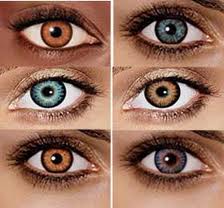
There are so many different types of contact lenses. For example, daily contacts lenses, that are only used for one day. There are colored contacts, where you can choose any colored contact of your choice and wear them. Astigmatism is a popular choice because so many people have it in the world. Astigmatism is a type of refractive error in the eye, it can cause blur in the vision. And there are contacts that help support the astigmatism. I have it myself, but it is only in my right eye and it is not as severe as some people may have it. They have created contacts that are usable for longs periods of time, and they have also created contacts where you dont have to take them out. Because it is a hassel having to put them on in the moring and then having to take them out right before you go to bed.

IV. Impact on World/Humanity

I believe that contact lenses has impacted the world and humanity in a positve way. Contact lenses are comfortable and it has given people a different option than just having to wear glasses all day long. For athletes, such as myself, it would not be comfortbale or productive to be wearing glasses while you are being active. Me personally, loves contacts and I dont know what I would do without contacts. They stay in your eye, you dont have to be messing with them every second, like ehat you would have to do with glasses. Plus, some companies it is cheaper to buy a set of contacts, then having to buy a pair of glasses. If a contact breaks then you just throw it away and open a new set, but if your lens on your glasses break then that is a whole different story.

V. Journal Article


In my journal article, it is a women by the name of Nina Shen Rastogi who believes contact lenses produce trash, but the their impact towards the enviroment is minimal. And the statistic that she refers to is the amount of plastic that we use for our contact lenses. She states that "a single pair of soft lenses weighs about 25 milligrams after it has been dehydrated. Twenty-six pairs of you biweekly lenses, would produce about 0.65 grams of dried out plastic" (http://www.washingtonpost.com/wp-dyn/content/article/2010/01/25/AR2010012503112.html). The statistics show that tons ofplastic is being used for these contact lenses that we use no more than a month, it maybe producing alot of trash and wasteful products, but it is not effecting our enviroment in any harmful way.


IV. List of References

Totally rare disease that you'll want to know about!!!

Sitosterolemia

I. Introduction:

Sitosterolemia is very different and unheard of disease. It causes the person that it is effecting to not be able to produce its own cholesterol, instead your body uses plants to produce the cholesterol for it and ends up producing too much and causes your body to do unhealthy things such as have a heart attack. The reason I chose to write about sitosterolemia is because two of my uncles have it. Although one has it less severe than the other they both have a problem with it and it makes their life harder. My uncle that has it more severe has had a very difficult life. The cholesterol problem caused him to have his many heart attacks and eventually had him retire a lot early than he expected to. This changed a lot for him financially and has struggled to keep food on his table for his family. As of 2000 there were only 40 worldwide diagnosis of this disease. William Connor and Ashim Bhattacharyya were the two doctors that found this disease in 1974. And further research has been done since.


II. Discovery:
There is not much information on the finding of this disease. The way Connor and Bhattacharyya found out about it is when two sisters came to them with a large amount of tendon xanthomas but after researching more they also had a regular plasma cholesterol level; but later they were found to have a very high plasma level of plant sterol. These plant sterols were formed in beta-sitosterol, stigmasterol, and campesterol. The doctors characterized the sitosterolemia by tendon, tuberous xanthomas, and a strong ability toward premature coronary atherosclerosis(Steiner, eMedicine).(emedicine.medscape.com)


III. Biography:
William Connor was a very intelligent doctor that not only loved medicine, but also was a very good teacher, and a very innovative biomedical investigator. William loved to challenge the already existing theories and prove them wrong. He graduated from the University of Iowa and went directly into the Army during World War II. After William finished the war he went back to college to get his MD degree and worked at the Iowa City Veterans Administration Medical Center and worked his way up to the top until he moved to Oregon and worked at the Oregon Health and Science University. That is where he kept his research on lipids and nutrition until he died. William’s first thing that found national interest was his work on human cholesterol metabolism. This happened when he started on dietary cholesterol, and with very careful control of plasma cholesterol concentration he was able to prove that dietary cholesterol was important. William really believed in cholesterol restriction and kept on a healthy diet. William really liked the outdoors and sports. He would encourage physical activity until the day that he couldn’t do it himself and that’s what probably lead him to prove the effects of dietary cholesterol.(Spector, William E. Connor, MD)


IV. Impact of the World/Humanity:
Although this disease does not affect the world greatly because as of 2000 only 40 patients were found worldwide, it still affects the world. People such as my Uncle have had to live with this disease and face its consequences for a long time. There is no age range and has been found in patients as young as 18 months old. This disease greatly affects your cholesterol and causes you to have to watch out for what you eat because of the fact that you are more prone to have things such as a heart attack. There is not much information about this out there and are even fewer patients. Although it is not as likely to get as aids or even cancer it still kills people and makes lives harder.


V. Journal Article Review:
The Journal Article is talking about a 31-year-old woman that has been recommended to the national institute of Health Lipid Clinic five years ago when she was 26. This has affected her for a long time and she will probably have to live with this for as long as she lives. The Journal Article also talks about when sitosterolemia was found. It says that Connor and Bhattacharyya talked about two sisters with a lipid storage disease; which had high concentrations of plant sterols that was located in red blood cells, skin, etc. There were other cases that happened with people not related to these two sisters such as the one before.(Shulman,www.nejm.org)


VI. Bibliography:
• Shulman, Richard. "Sitosterolemia and Xanthomatosis." NEJM. N.p., n.d. Web. 15 Feb. 2011. .


• Spector, Arthur. " William E. Connor, MD -- Spector 30 (4): e2 -- Arteriosclerosis, Thrombosis, and Vascular Biology." ahajournals. N.p., n.d. Web. 15 Feb. 2011.

• Steiner, Robert. "Sitosterolemia." eMedicine. N.p., 6 Mar. 2009. Web. 6 Mar. 2009. .

Pictures!!!!
http://www.google.com/imgres?imgurl=http://geneticpeople.com/wp-content/uploads/2010/04/expert_olho5.jpg&imgrefurl=http://geneticpeople.com/%3Ftag%3Dsitosterolemia&usg=__4ccw1rQei1VVV63V4ktK6ZpGtBc=&h=370&w=463&sz=9&hl=en&start=0&zoom=1&tbnid=5hi-IsEfaTHxFM:&tbnh=141&tbnw=176&ei=UzpbTYHgO4T48AbohdmGDQ&prev=/images%3Fq%3Dsitosterolemia%26hl%3Den%26biw%3D1174%26bih%3D775%26gbv%3D2%26tbs%3Disch:1&itbs=1&iact=hc&vpx=129&vpy=75&dur=982&hovh=201&hovw=251&tx=116&ty=123&oei=UzpbTYHgO4T48AbohdmGDQ&page=1&ndsp=20&ved=1t:429,r:0,s:0